
Tomorrow’s Safety Management System for Aviation
Tomorrow’s Safety Management System for Aviation
Safety Management Systems for Aviation
A Safety Management System (SMS) is a framework based on FAA/ICAO recommendations to anticipate and address safety issues before they lead to an accident. It measures risk across the enterprise and applies rules based on previous and predicted behaviour to improve safety and efficiency.
It is built on hazard reporting and risk assessment. A suitable SMS program will have 3 objectives.
- Gives all stakeholders a way to report hazards.
- Ensure that every hazard goes through a risk assessment and mitigation process.
- Provides a decision support matrix to help managers decide on launching suitable SOPs based on the probable severity and the risk assessment.
This approach delivers a systematic and standardized process for hazard assessment and underlying change management. And when this is applied across an airport, it means that critical decisions are made after evaluating and considering all potential risk. A Safety Management System is a critical central piece of the risk assessment and mitigation process.
Tomorrow’s Safety Management System– As an example, let’s look at the long tarmac delay ruling the U.S. Department of Transportation enacted a few years ago. Given technology’s foreseeable path, the following scenario will be possible soon:
A plane is on the tarmac waiting for an open gate. Since an arriving/ departing plane cannot stay on the tarmac for more than three hours per the regulation, airports develop plans to beat this window and avoid the fall-out. Given data and the appropriate model, AI can recognised this pattern setting off an action plan when it receives a Long Tarmac Delay signal (LTD) at the two-hour mark. When this happens, the appropriate departments can use that plan to move the plane and prevent the associated fines.
Technology will play a much more assistive role especially when stakeholders must make large, complex, and or long-term decisions.
Decision Engines and Change Management – Technology can be shaped to do a lot of proactive SMS work while also supporting stellar risk assessment. Professionals and stakeholders need to consider every kind of risk before moving to actionable models.
Preparing for the Future SMS– The future safety management system will be scripted to run decision support engines and handle change management.
An open system capable of integration is a key requirement. Databases should not in silos and communication between systems facilitates better decision making. The best case is a fully integrated software platform that bridges the full software application set.
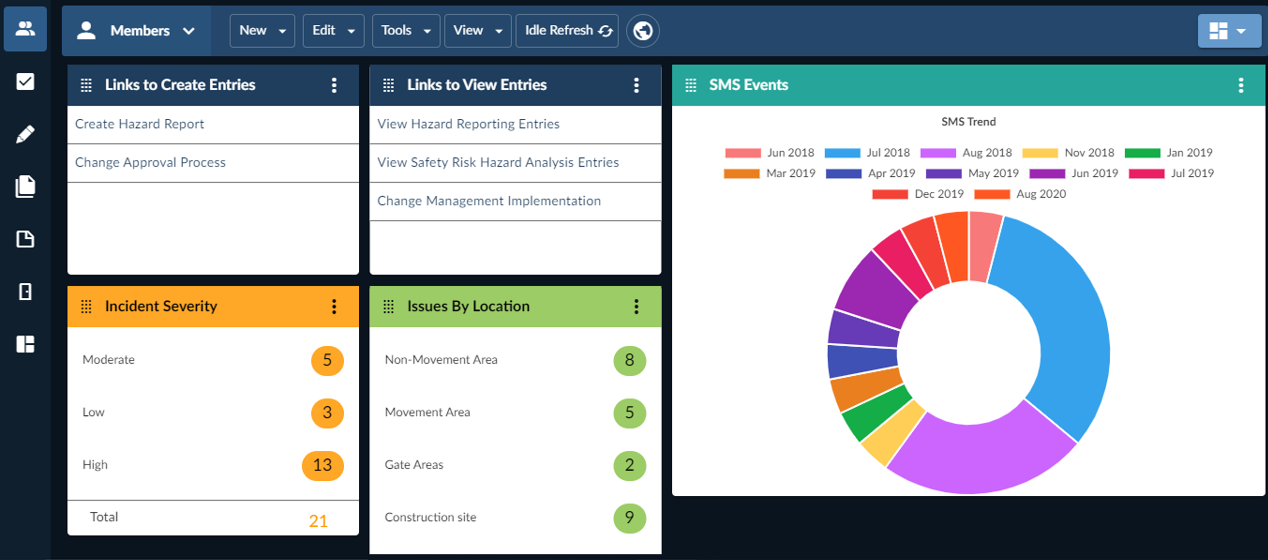
The safety management system is now a standard application for Aviation. An example would be a recent UA Engine Failure which triggered a large Risk Assessment exercise across airlines and engine manufacturers. The risk assessment programs needed to be flexible, agile, and rapidly deployable at scale. Veoci gives you a way to assess, add and mitigate risk and hazards by making the information quickly available in real time across the airline or airport or a group of airports under one operational management.
Veoci is a no-code cloud hosted platform with a full featured mobile app. The building blocks of the platform allow customers to easily create complex workflows and dashboards from managing emergency and crisis response to full operational Part 139/Annex 14 compliance reporting.
This in turn leads to Safety Management and BCP/DR strategy. BCP/DR is a start for application resilience and the Veoci platform with its feature set of forms, workflows and dashboards can also provide critical application workarounds when a crisis disables primary inhouse applications like in a case of a cyberattack.
Examples
- Large Airport Operator Operating Multiple Airports : With Veoci as a platform, we have configured a full airside application portfolio for Airports. These covers Emergency Management, Airside Operations and Compliance as well as a Safety Management System. This has been operational now for over 2 years. The Cloud Platform is ideal for airside management of multiple airports under one operator as Users across the organisation, based in different cities and responsible for different functions, can see real time data and collaborate to take quick and effective decisions. The industry is also highly regulated and real time validated data enables the organization to meet the highest compliance and regulatory standards. This will transform the operational profile of the organisation and lead to significant benefits in compliance, response, and cost. Availability of data also reduces the time for any Regulatory inspections to a matter of days rather than the couple of weeks.
- A leading Asian Airline: An Emergency and Crisis response Solutions across 50+stations and 20+ countries for a large APAC based airline. SOPs for a list of crisis / emergencies are now digital and the Airline can launch effective response to multiple crisis situations sending out a stream of tasks and forms for real time data that aggregates into a virtual cockpit, giving them the ability to make on the spot decisions. These are communicated using the In-app Communication suite which, without to leave or using another application, allows SMS, Email and Voice alerts and communications to be relayed across the airline and its many stations.
To learn more about how we can support you in building your Tomorrow’s Safety Management System, write to us at arpita.bohra@notephi.com.